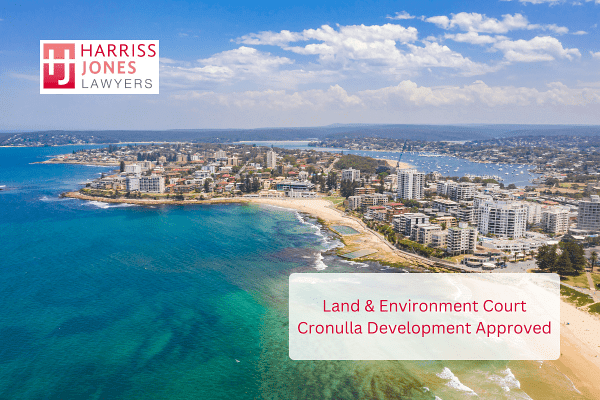
Case: Cronulla Esplanade Pty Ltd v Sutherland Shire Council [2026] NSWLEC 1037
Case Overview
The Land and Environment Court has upheld an appeal and granted conditional development consent for alterations and additions to a residential flat building at 34 The Esplanade, Cronulla. The approved changes include adding an additional level, a communal roof terrace, and strata subdivision to an already approved development.
The decision followed an agreement reached between the developer and Sutherland Shire Council after a conciliation conference, demonstrating how negotiated outcomes can resolve complex planning disputes even when initial negotiations fail.
Background
The development application (DA 25/0478) sought to modify an existing approval (DA 21/0628) by:
Adding a sixth storey (increasing building height to 22.2m)
Providing a communal roof terrace
Enabling strata subdivision
The original proposal attracted 18 submissions during public exhibition, with 5 in support and 13 objecting. Key concerns included building height exceedances, privacy impacts, and applicability of State Environmental Planning Policy (Housing) 2021 provisions.
Key Planning Issues and Court’s Findings1. Building Height Variation
The proposed height of 22.2m exceeded both:
The 16m limit under Sutherland Shire LEP 2015
The 22m standard under SEPP Housing
Court’s Finding: The Court accepted a written request under clause 4.6 of LEP 2015, finding the 0.2m exceedance was justified. The SEPP Housing standard of 22m prevailed over the local LEP standard due to statutory precedence rules.
2. SEPP Housing Compliance
The development qualified under SEPP Housing as it was within 400m walking distance of Cronulla Town Centre (a “low to mid rise housing inner area”).
Court’s Finding: The development satisfied key requirements including:
Compliance with Apartment Design Guide
Meeting car parking requirements
Providing adequate apartment sizes (222m² for new apartment)
Achieving 2.7m ceiling heights
Satisfying floor space ratio requirements (1.76:1 against 2.2:1 standard)
3. Coastal Planning Regulations
The site fell within Coastal Use and Coastal Environmental Areas under SEPP (Resilience and Hazards) 2021.
Court’s Finding: The modifications to an already approved development did not materially increase coastal hazard risks. The existing foundations and structural design remained unchanged.
4. Heritage Considerations
The site adjoins the Cronulla Esplanade heritage item.
Court’s Finding: The additional level would not generate impacts warranting refusal, particularly as the building form and setbacks remained consistent with the approved development.
5. Community Concerns
Objections focused on height, privacy, and applicability of housing policies.
Court’s Finding: Amendments made during proceedings addressed amenity concerns. The Court accepted that renotification wasn’t required as amendments reduced environmental impacts.
Important Legal Mechanism: Consent Consolidation
A significant aspect of the consent was Condition 6, which requires modification of the previous development consent (DA 21/0628) to ensure consistency.
How it works:
Uses powers under sections 4.17(1)(b) and 4.17(5) of the EPA Act
Requires submission of a “notice of modification” before construction certificate issue
Creates one consolidated consent for the entire site
Prevents potential conflicts between separate approvals
This approach provides certainty for both developers and council regarding which approval conditions apply.
Conditions of Consent
Key conditions include:
Payment of $3,000 costs to Council for amendment handling
Requirement to modify previous consent to align with new approval
Compliance with submitted amended plans and documents
Ongoing compliance with BASIX and sustainability requirements
Key Takeaways for Developers and Practitioners
Negotiated Outcomes Work: Even when conciliation conferences don’t immediately produce agreement, continued negotiation can lead to acceptable solutions that avoid costly hearings.
Minor Variations Can Be Justified: A well-prepared written request can support minor exceedances of development standards, particularly where environmental impacts are minimal.
Consolidate Approvals: Where modifying existing approvals, consider seeking conditions that formally consolidate consents to avoid regulatory uncertainty.
Amend Responsively: Addressing community and council concerns through plan amendments can resolve objections without requiring renotification.
Understand Instrument Hierarchy: Knowing which planning instrument prevails (here, SEPP Housing over local LEP) is crucial for assessing development potential.
Coastal Sites Need Careful Consideration: Even modifications to approved developments in coastal areas require assessment against hazard planning provisions.
Outcome
The appeal was upheld, and development consent granted subject to agreed conditions. The decision demonstrates how the Land and Environment Court can facilitate practical solutions that balance development objectives with planning controls and community concerns.
This summary provides general information only and does not constitute legal advice. Planning law is complex and fact-specific. For advice on your development proposal, contact our planning and environment law team.

