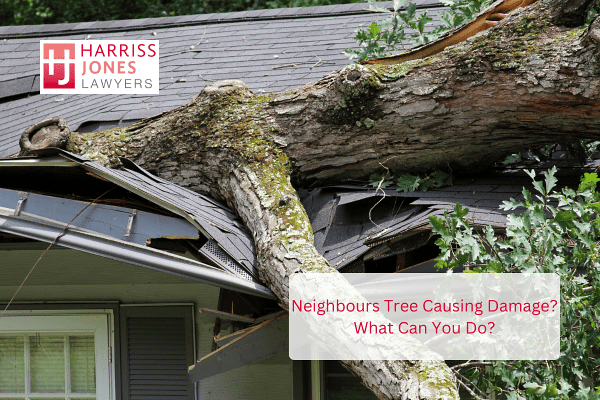
A recent Land and Environment Court case clarifies your rights regarding overhanging trees, deadwood damage, and who pays for the pruning.
Dealing with a neighbour’s tree can be one of the most frustrating property disputes. Branches overhang your roof, deadwood litters your garden, and you worry about a large limb falling on your car or, worse, a loved one. You ask your neighbour for help, but you are ignored, denied, or told it is “an act of God.”
A recent decision by the NSW Land and Environment Court, Wong v Chan [2026] NSWLEC 1283, provides a clear roadmap for how these disputes are resolved. It also serves as a warning to tree owners: ignoring a dangerous tree can be an expensive mistake.
The Case at a Glance
Mr Wong and Ms Chan were neighbours in Pymble. A large Sydney blue gum on Ms Chan’s property overhung Mr Wong’s home, carport, and garden. Over several years, falling deadwood cracked his roof tiles, dented his car, and smashed his garden lights.
Despite repeated requests, Ms Chan (through her property manager) refused to take responsibility. At one point, the property manager argued that concrete roof tiles “harden with age” and could not possibly be broken by small sticks.
Mr Wong eventually applied to the Land and Environment Court under the Trees (Disputes between Neighbours) Act 2006.
The Outcome: A Win for the Homeowner
The Court ordered that Ms Chan must:
Pay compensation of $1,523.22 for the damage to the roof, car, and garden lights.
Hire a qualified arborist to remove all deadwood over 10mm in diameter from the branches overhanging Mr Wong’s property within 45 days.
Maintain the tree on a regular schedule (every two years, starting in June 2028) to remove deadwood going forward.
Cover all costs for this ongoing maintenance.
Crucially, the Court rejected the property manager’s excuses. The Commissioner found that deadwood from the tree was the probable cause of the damage and that the tree owner had a duty of care to act.
Key Lessons for Homeowners (Like You)
If you are dealing with a neighbour’s tree that is causing or threatening damage, here is what you need to know from the Wong v Chan decision:
1. Deadwood is not an “Act of God.”
The Court confirmed that when a tree owner is put on notice that their tree contains dangerous deadwood, they have a legal duty to manage it. Falling deadwood is foreseeable, not a random act of nature. If they ignore it, they can be held liable for compensation.
2. You do not have to pay for pruning of overhanging branches.
While you generally have the right to prune branches back to the boundary line (at your own cost), this case shows the Court can order the tree owner to pay for professional pruning—especially where deadwood poses a risk to your home or safety.
3. You must show you tried to resolve the dispute first.
Mr Wong won because he had a long paper trail. He sent emails, requested mediation through a Community Justice Centre (multiple times), and gave the owner every chance to fix the problem. The Court will not make an order unless you have made a “reasonable effort to reach agreement.”
4. You can claim compensation for past damage.
If a branch or deadwood from a neighbour’s tree has already damaged your property (roof, car, fences, lights), you can claim the repair costs. Make sure you keep receipts, photos, and a diary of events.
5. The Court can order ongoing maintenance.
This is a powerful outcome. The Court did not just order a one-off clean-up. It ordered a recurring pruning schedule for years to come. This prevents the problem from recurring and forcing you back to court.
What You Should Do Right Now
If you are worried about a neighbour’s tree:
Document everything. Take dated photos of the tree, the deadwood, and any damage to your property.
Communicate in writing. Send a polite, clear email or letter to your neighbour outlining the problem and requesting action. Keep copies.
Get professional advice. A qualified arborist can assess the tree and provide a report on the risk it poses.
Try mediation. Before rushing to court, consider free or low-cost mediation through the Community Justice Centre.
Seek legal advice. The Trees Act is technical. A lawyer can help you navigate the process and prepare an application to the Land and Environment Court if necessary.
The Bottom Line
Wong v Chan is a clear reminder that tree owners cannot bury their heads in the sand. If their tree is dropping deadwood onto a neighbour’s home, they are responsible for the damage and the cost of making the tree safe.
As a homeowner, you have rights. The Court can order compensation, forced pruning, and ongoing maintenance. You do not have to simply tolerate a dangerous tree next door.
Have a tree dispute? Our firm can help you understand your options, negotiate with your neighbour, and, if necessary, represent you in the Land and Environment Court. Contact us today for a consultation.
Disclaimer: This article is based on the published judgement in Wong v Chan [2026] NSWLEC 1283 and is for informational purposes only. It does not constitute legal advice. You should consult with one of our qualified legal professionals regarding your specific circumstances.

