
Separation doesn’t have to mean conflict and drawn-out court battles. Family Law Collaborative Practice offers a supportive and solutions-focused way for families to move forward during separation or divorce.
In Collaborative Practice, both parties commit to resolving issues outside of court. Meetings happen in a respectful, open setting, where everyone is supported by their own lawyer. This process encourages cooperation and honest communication, helping reduce misunderstandings and mistrust. It’s usually quicker, less stressful and more cost-effective than traditional litigation.
Collaborative Practice can also involve other professionals, such as financial advisors, child consultants, and communication coaches. Their expertise helps address complex emotional, financial, and parenting issues so families can find solutions that work for everyone’s wellbeing — especially children.
How does the collaborative process work?
Initial Consultation: Before the process formally starts, each party meets privately with their own collaborative lawyer. During these confidential meetings, clients can discuss their goals, expectations, and any concerns they might have. The lawyer also explains the collaborative process and the importance of trust, transparency, and acting in good faith.
Participation Agreement: Both parties and their lawyers sign a formal participation agreement. This sets out the commitment to resolve disputes without litigation and establishes the ground rules— including promises of honesty, respect, and openness. All agree that if someone commences court proceedings, both lawyers must stop acting for their clients in that matter.
Four-Way Meetings: Collaborative matters are typically resolved through a series of structured face-to-face meetings, known as four-way meetings. These are attended by both parties and their lawyers, and sometimes neutral experts (such as child specialists, financial advisers, or counsellors) if needed. These meetings provide a safe and respectful environment to identify issues, exchange information, and work towards agreement on solutions.
The Role of Experts: Where useful, neutral professionals are brought into the process— for example, a child specialist may help develop child-focused arrangements, or a financial adviser may clarify financial matters. Experts are engaged jointly and act as a neutral resource to assist both parties.
Disclosure and Information Sharing: Both parties must provide full and frank disclosure of all financial and relevant personal details. This transparency is essential for informed decision-making and ensures fairness in negotiations.
Issue Identification and Option Development: Collaborative lawyers support clients to clarify their interests and identify the main issues in dispute. With this clarity, the group develops possible options and solutions together, aiming for arrangements that meet the needs and interests of both parties and any affected children.
Negotiation and Decision Making: The team evaluates available options, encourages creative problem-solving, and helps the parties assess whether proposed solutions will work in practice. There is a strong emphasis on consensus, not just compromise— aiming to reach durable agreements.
Finalisation: Once an agreement is reached, the lawyers will prepare the necessary legal documents to formalise the arrangement (such as financial agreements or consent orders for parenting matters). These documents can be filed with the court for enforceability, if required.
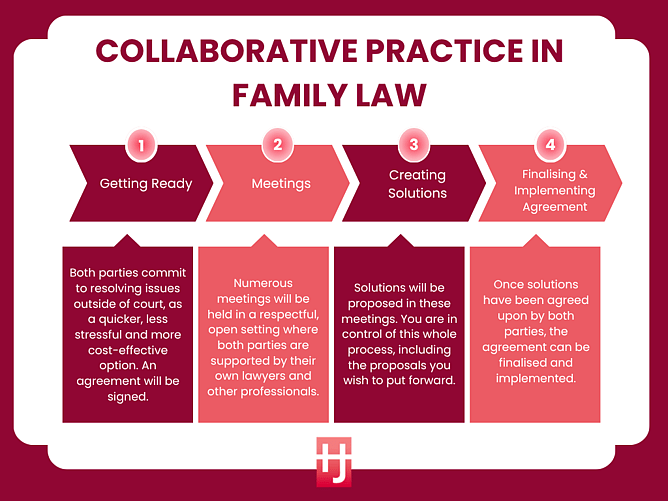
Throughout the collaborative process, the focus stays on respectful communication, transparency, and finding solutions in the best interests of the family as a whole. This approach is especially valuable in matters involving children, as it seeks to preserve relationships and reduce conflict.
But what if the process breaks down?
All participants are committed to staying out of court while using collaborative practice. If the process cannot resolve the issues and litigation becomes necessary, both collaborative lawyers (and any involved experts) must withdraw, ensuring clear boundaries between the collaborative process and court proceedings.
FAQs
What is Collaborative Practice? Collaborative Practice is a way to resolve family law issues without going to court. It brings together you, your partner, and a team of professionals (such as lawyers, financial advisors, and child specialists) to work collaboratively towards the best solutions for everyone involved.
How can Collaborative Practice help my family? This approach respects the needs of all parties, minimises conflict, and supports open communication. It can help reduce stress for both adults and children, allowing separated parents to maintain a healthier working relationship for co-parenting. Child specialists can be included to help advocate for your child’s needs.
How is Collaborative Practice different to mediation? Unlike mediation, where an independent mediator helps you negotiate but cannot give legal advice, Collaborative Practice provides each party with their own lawyer and may include other professionals for additional support and advice.
Is Collaborative Practice always suitable? Collaborative Practice is ideal when both parties are committed to resolving issues respectfully and transparently. It is not recommended if there is unwillingness to share information, coercion, or a history of family violence. A collaborative professional can help assess suitability.
Will my case still go to court? In Collaborative Practice, both parties sign an agreement committing to stay out of court. If the process breaks down and court becomes necessary, both collaborative lawyers must withdraw, and the process ends.
Where can I learn more about Collaborative Practice or find a Collaborative professional? For more information and to find a qualified Collaborative Practitioner, visit the Australian Association of Collaborative Professionals (AACP) website: https://www.collaborativeaustralia.com.au/
If you wish to explore Collaborative Practice as an option for your settlement process, contact our collaborative lawyer today to discuss how we can support you.

