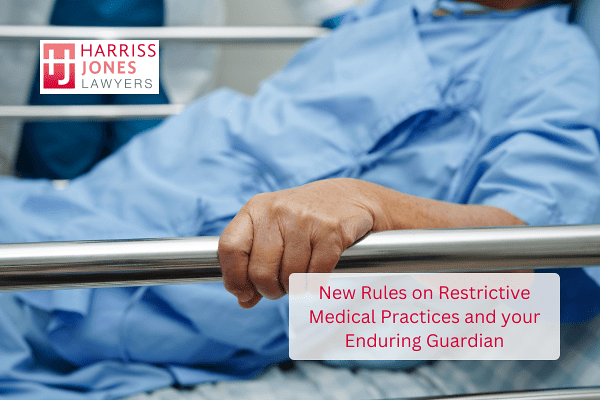
Restrictive medical practices and your Enduring Guardian
If you have appointed an Enduring Guardian, or you are thinking about it, there is an important update you should know about. It is about something called “restrictive practices”, and it changes what your guardian can and cannot do for you.
An Enduring Guardian is someone you choose to make lifestyle and health decisions for you, if you ever lose the ability to make them yourself. This might be after an accident, a stroke, or as dementia progresses. You appoint them now, while you have full capacity, so they are ready to step in later.
What is a “restrictive practice”?
A restrictive practice is anything that limits a person’s freedom of movement or choice, usually to keep them safe. Common examples include:
● Locking a door or gate to stop someone leaving a room or building
● Using rails, harnesses or furniture to stop someone getting up or moving around
● Giving medication mainly to calm or control someone’s behaviour, rather than to treat a diagnosed illness
● Using an alarm or sensor that restricts where someone can go
These practices are sometimes used in aged care and disability care settings. They can be necessary at times, but they take away some of a person’s freedom. Because of this, the law treats decisions about restrictive practices more carefully than everyday lifestyle decisions.
What has changed
The NSW Government has updated its guidance on how Appointments of Enduring Guardian work. Restrictive practices are no longer treated as an automatic part of your guardian’s general power to make lifestyle and health decisions for you.
This means that unless your Appointment of Enduring Guardian specifically says your guardian can make decisions about restrictive practices, they will not be able to consent to one being used on your behalf. It has to be spelled out.
The NSW Civil and Administrative Tribunal (NCAT), which oversees guardianship matters, has also published new guidance on restrictive practices for guardians. This reflects a broader move across aged care and disability services to make sure restrictive practices are only used with clear, informed consent.
Why this matters
This change is about protecting people’s rights and dignity. Restrictive practices can have a big impact on someone’s day to day life, so the law wants to make sure a real decision has been made about who can consent to them, not just an assumption.
For you, it means being clear and deliberate when you set up your Appointment of Enduring Guardian. If you want your guardian to be able to make these decisions for you, your document needs to say so.
If you already have an Appointment of Enduring Guardian
If you appointed your guardian before this update, your existing document may not cover restrictive practices at all. That does not mean your appointment is invalid. It simply means your guardian may not have the authority to consent to a restrictive practice if the need arises.
It is worth reviewing your appointment, especially if you or a loved one may need aged care or disability support down the track. A short conversation now can save confusion and delay later, at a time when your family is already dealing with enough.
What to do next
If you are appointing an Enduring Guardian for the first time, we can make sure restrictive practices are properly addressed in your document, in a way that reflects what you actually want.
If you already have an Appointment of Enduring Guardian, we can review it with you and update it if needed.
This is one of those quiet but important pieces of planning. It does not need to be complicated, and we are here to make it easy to understand and act on.
Get in touch with our team at Harriss Jones Lawyers to talk through your Appointment of Enduring Guardian. You can find us at www.hjlaw.com.au.
The team at Harriss Jones Lawyers