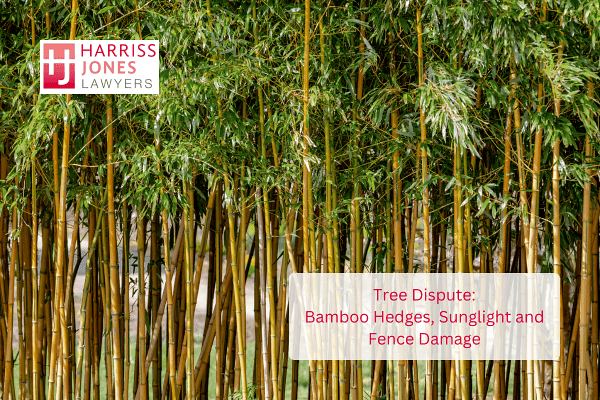
A recent NSW Land and Environment Court case shows that while you can't always force a neighbour to remove a bamboo hedge, you can get orders for ongoing maintenance, pruning, and fence repairs.
For many that are in disputes with neighbours over trees and hedges know they can be complex. This is especially true when the plant in question is a fast-growing, tall bamboo hedge.
A recent decision in the NSW Land and Environment Court, Winterthur Pty Ltd v Spring [2026] NSWLEC 1342, provides a helpful roadmap for property owners and strata corporations dealing with a neighbour’s bamboo that is both damaging a dividing fence and blocking sunlight to apartments.
In this case, the owner of an apartment building (Winterthur) took action against the neighbouring homeowners (Mr Spring and Ms Sullivan) over a 10-metre-tall bamboo hedge planted along their shared boundary. The applicant initially wanted the entire hedge removed. But after getting expert advice, they changed their approach – and the Court ultimately agreed with a more balanced solution.
Here’s what you need to know.
Two Legal Claims Under the One Act
The case was brought under two parts of the Trees (Disputes Between Neighbours) Act 2006 (NSW):
Part 2 – for property damage: The bamboo was pushing against and damaging the timber dividing fence.
Part 2A – for severe obstruction of sunlight: The bamboo was blocking direct sunlight to several apartment windows (including living areas and bedrooms).
Key Issue 1: Damage to the Fence
The Court found that the bamboo’s rhizomes (underground stems) and culms (upright canes) were the primary cause of the fence palings being pushed out of place. The neighbours argued that dampness was the main culprit, but the Commissioner’s onsite observation confirmed the bamboo was the key problem.
What the Court ordered for the fence:
The neighbours must remove bamboo rhizomes and culms within 300mm of the boundary wall/fence every year (in July and April) to prevent future damage.
Both parties must share the cost equally to repair the damaged paling fence. They will each get two quotes and choose the cheapest contractor.
Key Takeaway: Even if you don't seek compensation, you can get orders to prevent future damage and compel your neighbour to share repair costs.
Key Issue 2: Blocking Sunlight (The Hedge)
This was the main battleground. The bamboo formed a ‘hedge’ over 2.5 metres tall, so Part 2A of the Act applied. For the Court to make orders, the applicant had to prove the obstruction was “severe” – not just minor.
The applicant provided detailed shadow diagrams from an expert builder, showing that several windows received zero hours of direct sunlight during winter and equinox because of the bamboo. For example:
A bedroom window (W3) went from 4 hours of sun to nil.
A living room window (W10) went from 5 hours to nil.
A kitchen window/door (W17 & W18) went from 3-4 hours to nil.
The neighbours argued that ‘dappled light’ still came through and that you could read a newspaper without turning on lights. The Court rejected this – the legal test is about direct sunlight, not ambient light. The Commissioner found the obstruction was indeed severe for several windows.
Balancing Act: Privacy vs. Sunlight
The neighbours valued the bamboo for its privacy and amenity – it screened the apartment building, which they felt was unattractive and allowed overlooking into their garden.
The Court had to balance:
The applicant’s interest in removing the severe sunlight obstruction.
The neighbours’ interest in keeping their privacy screen.
What the Court ordered (instead of full removal):
The Court did not order the complete removal of the bamboo. Instead, it ordered a practical compromise:
Remove a 2-metre wide section of bamboo directly outside the worst-affected windows (Units 1, 5 and 9). This must be done annually in July and April, including roots, rhizomes and culms.
Prune the remaining bamboo annually to the height of the midpoint of a specified window (Window W10 in Unit 5).
The neighbours must pay for a qualified horticultural contractor to do the pruning if they can’t do it properly themselves.
Practical Tips for Clients from this Case
If you are considering legal action over a neighbour’s tree or hedge, this case highlights several important lessons:
Get expert evidence early. The applicant here changed their position from “remove everything” to “prune and maintain” after their own arborist gave expert advice. That made their final orders more reasonable and more likely to be granted.
Document everything. The applicant’s shadow diagrams and expert reports were crucial to proving “severe” obstruction. Your own opinion is not enough – you need objective evidence.
Make a reasonable effort to negotiate. Even though there was a long gap in correspondence, the Court found the applicant had tried to reach agreement before coming to court. You don't have to negotiate forever, but you must show a genuine effort.
The Court looks for balance. The Commissioner rejected both extremes – full removal (too harsh) and doing nothing (unfair to the applicant). Instead, the Court crafted ongoing, annual maintenance orders that preserved privacy where possible but restored sunlight where the obstruction was severe.
Costs are tricky. Commissioners of the Court (who hear most tree disputes) do not have power to award costs. If you want to claim your legal costs, you need to file a separate motion.
Conclusion
Winterthur v Spring is a classic example of how the Trees Act works in practice. It is not an automatic right to cut down your neighbour’s hedge. But it is a mechanism to get practical relief – whether that’s fixing a damaged fence, restoring lost sunlight, or both.
If you are living in the shadow of a neighbour’s bamboo or fighting a constant battle with damaged fencing, the key is to gather expert evidence, make a genuine effort to negotiate, and then seek court orders that are targeted and reasonable. A blanket demand for removal may fail, but a well-reasoned application for maintenance, pruning and repair is likely to succeed.
Need advice on a neighbour tree dispute? Contact our office to discuss how we can help you navigate the Trees Act and find a practical solution.
This article is not a substitute for tailored legal advice and should not be considered as such. If you are having trouble with a neighboring tree, you should seek legal advice which considers your individual situation.

